

CBD and CBN: Which Cannabinoid Is Right for Your Wellness Goals?
Choosing between CBD and CBN affects therapeutic benefits, sleep quality, dosing requirements, and overall wellness outcomes. CBD delivers broad-spectrum daytime support-anxiety relief, pain management, anti-inflammatory action-backed by extensive clinical trials and an FDA approved medication.
CBN targets a narrower niche: sleep support and nighttime relaxation, with promising but still limited human research. The right cannabinoid depends on your specific health goals, time of day usage, and desired effects.
Below is a practical comparison of CBD vs CBN for informed decision-making.
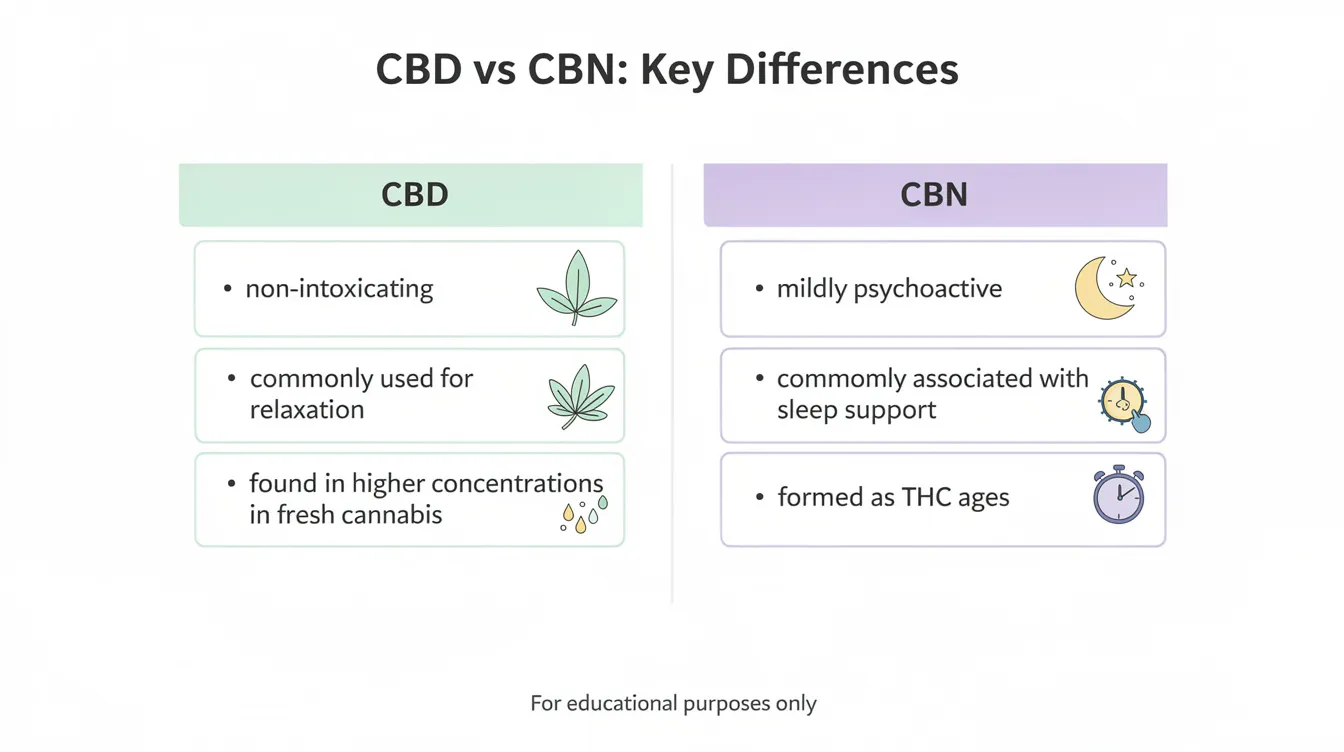
Table of Contents
CBD vs CBN: Key Differences
The key differences between these two cannabinoids come down to breadth of benefits versus specificity of purpose.
- CBD focuses on broad-spectrum wellness including anxiety relief, pain management, and daily stress reduction, and it is often discussed alongside THC as one of the major cannabinoids. It is the most widely studied cannabinoid after THC, which remains the main psychoactive component of cannabis, and CBD has well-documented health benefits across multiple medical conditions.
- CBN targets specific needs like sleep support, sedation, and nighttime relaxation. It is primarily marketed as a sleep aid for its sedative effects, though research suggests its reputation may outpace the current evidence.
- Both CBD and CBN are non-intoxicating cannabinoids derived from cannabis and hemp plants, but they serve different wellness purposes and have vastly different levels of scientific validation.
- Understanding their distinct properties helps optimize cannabinoid therapy-whether you consume CBD daily for calm focus or use CBN products before bed.
Origins and Formation in Cannabis and Hemp Plants
How each cannabinoid develops in the cannabis plant determines its availability, cost, and characteristics.
CBD Formation
CBD is a major cannabinoid found abundantly in hemp. It occurs naturally through the plant’s biosynthetic pathway: CBGA converts to CBDA, which then decarboxylates into CBD. This means CBD is extracted directly from fresh plant material with consistent potency-no aging or degradation required.
Because CBD is abundant in most hemp plants, extraction methods are well-established with reliable quality control. Production is cost-effective, and the supply chain for cannabinoid products containing CBD is mature. This is why CBD is more popular and widely available than CBN across dispensaries, health stores, and online retailers.
CBN Formation
CBN forms through an entirely different process. Rather than being synthesized by the living cannabis plant, CBN is formed from the degradation of THC over time-when cannabis ages or is exposed to light, heat, and oxygen. Cannabis plant age directly influences CBN concentration; older material contains more CBN as its THC components break down.
This reliance on THC degradation means CBN requires aged plant material or specific processing techniques for extraction. Lower natural concentrations make CBN products more expensive and less available. Manufacturers must use controlled THC breakdown or semi-synthetic methods, and the production process introduces additional quality concerns, including potential THC remnants and inconsistent purity. This is why third-party certificates of analysis (COAs) verifying heavy metals, pesticide residues, and THC content are especially critical for CBN oil and CBN gummies.
Effects, Pain Relief, and Therapeutic Benefits
Each cannabinoid produces distinct therapeutic effects suited for different wellness applications, largely because of how they interact with the endocannabinoid system.
The Endocannabinoid System regulates mood, sleep, and appetite. The ECS was identified in the early 1990s by researchers and consists of receptors, endocannabinoids, and enzymes that maintain homeostasis throughout the body. How CBD and CBN engage this system differs fundamentally.
CBD Effects and Side Effects
CBD interacts with the ECS indirectly, influencing various receptors rather than binding directly to cannabinoid receptors CB1 and CB2. Instead, CBD modulates receptors throughout the body to maintain balance-inhibiting the enzyme FAAH (which raises natural anandamide levels), activating TRP channels like TRPV1, engaging 5-HT1A serotonin receptors, and influencing PPARγ receptors. This broad mechanism explains why CBD’s potential benefits span so many areas.
CBD is commonly used for daytime wellness applications:
- Anxiety and mood: CBD may help reduce anxiety symptoms in patients. Several randomized controlled trials have tested doses of 300–600 mg/day for social anxiety and generalized anxiety disorder, showing meaningful symptom reduction in both acute and longer-term use.
- Pain relief and inflammation: CBD is effective for managing chronic pain and inflammation. Animal and human studies indicate it reduces pain via anti inflammatory cytokine modulation, prostaglandin downregulation, and oxidative stress management-functioning through the central nervous system and peripheral analgesics pathways.
- Epilepsy: CBD can significantly lower symptoms of certain epilepsy syndromes. The FDA approved Epidiolex as a purified CBD medication for Dravet syndrome, Lennox-Gastaut syndrome, and tuberous sclerosis complex, with seizure reductions often reaching 35–60%.
- Daily wellness: CBD maintains alertness while promoting calm and mental clarity, making it suitable for multiple consumption methods throughout the day without psychoactive effects.
CBN Effects
CBN interact with the endocannabinoid system through weak activity at CB1 receptors, with about 25% of THC’s effectiveness, making it a less potent cannabinoid and a weaker version of THC’s receptor activity. It is also believed to bind weakly to CB1 receptors, giving it mild psychoactive properties, though these are negligible at typical doses. CBN also acts as an agonist at multiple TRP channels (TRPV1-4 and TRPA1) and a potent antagonist of the TRPM8 channel.
CBN is primarily associated with promoting relaxation and sleep:
- Sleep: CBN has shown potential as a sleep aid. A double-blind, randomized, placebo-controlled trial with approximately 293 participants found that 20 mg CBN nightly for seven nights significantly reduced the number of awakenings and overall sleep disturbance compared to placebo. However, it did not significantly impact how quickly participants could fall asleep, wake after sleep onset (WASO), or daytime fatigue.
- Pain: CBN may relieve muscle and joint pain in animal studies. Preclinical research in a rat model of myofascial pain shows analgesic potential, but robust human data is lacking. CBN activated predominantly larger sensory neurons in mouse studies and showed an inverted U-shaped dose-response curve-meaning there is a dose beyond which the effect actually decreases.
- Appetite: CBN may help increase appetite according to studies, an effect distinct from CBD’s profile.
- Emerging areas: Early preclinical work has explored whether cannabinol inhibits cellular proliferation and cannabinol delays symptom onset in certain disease models, including research in transgenic mice related to amyotrophic lateral sclerosis, though human evidence in these areas remains absent.
CBN is frequently used in products aimed at nighttime use, and its effects are best suited for evening consumption due to potential drowsiness.

Potency and Dosing Requirements
Dosing considerations differ significantly between these cannabinoids, and finding the right cannabinoid and terpenoid doses requires understanding each compound’s potency profile.
CBD Dosing
CBD dosing depends heavily on the target condition:
- Daily wellness and stress relief: Many users take 10–50 mg daily. These lower doses are common in general wellness contexts but are less studied in rigorous clinical trials for anxiety.
- Anxiety: Clinical psychopharmacology research has used 300–600 mg/day in RCTs targeting anxiety disorders.
- Seizure disorders: Epidiolex dosing starts at 5 mg/kg twice daily, titrated up to approximately 20 mg/kg/day-substantially higher than wellness doses.
CBD is well-tolerated at higher doses with side effects that are generally mild: dry mouth, GI upset, drowsiness, changes in appetite, and possible liver enzyme elevations. The most significant risks involve drug interactions-CBD inhibits CYP3A4 and CYP2C19 enzymes, which can affect how other medications are metabolized. Medical cannabis patients taking warfarin, certain SSRIs, or benzodiazepines should consult their physician. CBD can be used multiple times daily across various consumption methods without building significant tolerance.
Regarding bioavailability: sublingual tinctures have a bioavailability of 40–50%, while edibles have a bioavailability between 4–20%. Smoking cannabinoids provides effects in 5–10 minutes but is not recommended for wellness use.
CBN Dosing
CBN dosing data is much sparser, and more research is needed to establish clear guidelines:
- Sleep maintenance: The primary human trial used 20 mg nightly for seven nights, showing meaningful reductions in awakenings. This is one of the first controlled dose points available.
- Acute sleep effects: The CUPID study tested single doses of 30 mg and 300 mg of oral CBN two hours before sleep in people with insomnia, measured via polysomnography.
CBN is best used once daily in the evening to avoid daytime drowsiness. Higher doses may risk increased sedation or next-day grogginess, but long term effects and maximum tolerated doses in humans remain largely undefined. Because CBN is metabolized by CYP2C9 and CYP3A4, drug interactions are plausible-though less documented than CBD’s. Anyone taking multiple medications should exercise caution, as these cannabinoids interact with similar enzyme pathways.
An important finding for those considering combining multiple cannabinoids: in the 293-participant trial, adding varying CBD doses to 20 mg CBN did not improve sleep outcomes beyond CBN alone. The combinations act similarly to CBN in isolation, meaning the entourage effect-where many wellness brands blend CBD and CBN to leverage synergy-may not apply to sleep in the way marketing often implies.
Research and Medical Recognition
The gap in cannabinoid research between CBD and CBN is substantial, and this should inform how much confidence you place in each.
CBD Research Status
CBD is well-researched with FDA-approved applications. Thousands of published studies document its safety and efficacy profiles across epilepsy, anxiety, pain, inflammation, and other conditions. It is the most widely studied cannabinoid after THC, and well-established drug interactions and contraindications are documented in clinical psychopharmacology and oral biology literature, among other fields.
That said, gaps remain. Long-term effects in diverse populations, effects during pregnancy, and interactions in polypharmacy settings need further study. The FDA continues to warn that CBD may cause hepatotoxicity at high doses, and it’s illegal to market CBD in food or as dietary supplements under current federal regulations.
CBN Research Status
CBN is under-researched with most evidence being anecdotal or preliminary. No FDA-approved medications containing CBN currently exist. Research on CBN is limited compared to CBD, requiring more studies-particularly well-powered clinical trials using polysomnography and measuring effects on sleep architecture (REM, deep sleep stages), next-day impairment, and long term effects of nightly use.
The evidence that does exist is suggestive rather than conclusive. Animal studies have explored CBN’s potential effects on pain, the immune system, cellular proliferation, and appetite, but human translation remains minimal. Key unanswered questions include optimal doses for sleep without next-day impairment, safety during chronic use, how CBN might interact with other compounds and medications, and whether it has meaningful applications beyond sleep-such as in reducing pain or affecting survival in neurodegenerative disease models.
Emerging areas of interest noted in published reviews include CBN’s potential anti-microbial properties, appetite stimulation, and early preclinical findings relevant to conditions like adult ADHD status assessment and amyotrophic lateral sclerosis-though none of these have human trial support. Publications in journals like Rambam Maimonides Medical Journal and others have begun cataloging minor cannabinoid pharmacology, but the field remains young.

Legal Status and Availability
Regulatory status influences product access, quality assurance, and your confidence as a consumer.
- CBD and CBN are legal in the US at the federal level when derived from hemp. The 2018 Farm Bill legalized hemp and hemp-derived substances like CBD, defining legal hemp as Cannabis sativa containing less than 0.3% THC by dry weight. Hemp-derived products must contain less than 0.3% THC to be legal.
- State laws vary regarding the legality of CBD and CBN products. Some states impose additional restrictions on cannabinoid products regardless of federal status, particularly concerning THC analogs or marijuana-derived compounds.
- CBD products are widely available in dispensaries, health stores, and online retailers. Both cannabinoids can be found in oils, gummies, and creams. CBD can be consumed as oils, edibles, and tinctures. CBN is available in oils and edibles, though with fewer manufacturers and higher costs per milligram.
- CBN’s legal status sits in a grayer area than CBD’s because it is derived from THC oxidation. If the final CBN product is hemp-derived and THC content remains under the legal limit, it generally aligns with federal law-but verification through lab testing is essential.
- For both cannabinoids, look for products with transparent third-party COAs showing potency, purity, THC limits, absence of contaminants, and hemp source. Keep in mind that a CBN or CBD product could potentially cause you to fail a drug test if it contains trace THC above labeled amounts-mislabeling remains a documented industry problem.
CBD vs CBN: Which Should You Choose?
Choose CBD if you need daytime wellness support, anxiety management, broad therapeutic benefits, and well-researched treatment options. CBD’s extensive safety profile, diverse consumption methods, wide availability, and non psychoactive daytime profile make it the more reliable choice for most people seeking pain management, stress reduction, or general health improvement. Research suggests CBD is the cannabinoid with the strongest evidence base among all other cannabinoids besides THC.
Choose CBN if you have sleep difficulties-specifically trouble staying asleep-and need evening relaxation support with targeted sedative properties. A nightly dose of approximately 20 mg shows promise for improving sleep maintenance and reducing awakenings, though you should not expect dramatic changes in how quickly you fall asleep. Be prepared for limited product availability, higher costs, and the reality that CBN remains a less well-understood compound with potential risks that haven’t been fully characterized.
Both cannabinoids can complement each other for comprehensive wellness coverage, with CBD supporting daily needs and CBN enhancing nighttime recovery-though current evidence does not confirm that combining them produces superior outcomes to using each individually for its intended purpose.
At UprightCBD, we never accept payment for reviews. Our goal is straightforward: help readers across the United States understand the unbiased truth about CBD and CBD-related products so they can make genuinely informed decisions about improving their lives.

Recent Comments