

The top results for “best rosin press” are mostly press sellers and forum threads, and the round-ups among them rank presses by tons. Tons measure force, not the pressure on your material. That pressure is force divided by bag area, so the bag you use matters as much as the press. This guide converts six presses’ rated force into pressure per bag size and cost per ton. For most home growers, the Rositek 8 Ton Hydraulic at $469 is the best value. For a few grams at a time, the $289 Rositek 2 Ton Manual is enough.
How we chose: We did not test these presses. Force, plate size, temperature and capacity come from each maker’s or seller’s page, and prices were checked on 27 September 2026. Most of those sources sell presses. Pressure figures are UprightCBD’s arithmetic from their ratings. UprightCBD sells no presses and earns nothing from any product named here.
Table of Contents
Our picks at a glance
- Best for most home growers: Rositek 8 Ton Hydraulic, $469. The lowest cost per ton of force here, and enough for 1,000 psi on a 3×5-inch bag.
- Best budget manual press: Rositek 2 Ton Manual, $289. Reaches flower pressure on a 2×2-inch bag, for up to 5 grams.
- Best premium press: NugSmasher Touch 12 Ton, $2,676. Does the pressure math on its touchscreen.
- Best for trying rosin: Ju1ceBox, $99. A heated hand clamp for a gram at a time.
| Press | Price | Rated force | Plates | Capacity | Largest bag at 1,000 psi | Cost per ton |
|---|---|---|---|---|---|---|
| Ju1ceBox | $99 | Not specified | 1×1.5 in | Up to 2 g | Cannot be calculated | — |
| Dulytek DM800 | $199; $249 bundle | 850 or 1,500 lb (maker pages differ) | 2.5×3 in | Not stated | 0.85–1.5 in² | $265–$468 |
| Rositek 2 Ton Manual | $289 | 2 tons (4,000 lb) | 3×3 in | Up to 5 g | 4 in² (2×2 bag) | $144.50 |
| NugSmasher Mini | $429 (sold out) | 2 tons (4,000 lb) | 2.5×2.5 in | Up to 7 g | 4 in² (2×2 bag) | $214.50 |
| Rositek 8 Ton Hydraulic | $469 | 8 tons (16,000 lb) | 3×7 in | Up to 28 g | 16 in² (3×5 bag fits) | $58.63 |
| NugSmasher Touch 12 Ton | $2,676 | 12 tons (24,000 lb) | 4×6 in | Up to 28 g | 24 in² (whole plate) | $223 |
Prices and specs from Dulytek’s own pages (DM800) and Trimleaf’s product pages and review (the others), checked 27 September 2026. Cost per ton is price divided by rated force. Pressure is UprightCBD’s calculation at 2,000 lb per ton.
Rosin press key facts
- Pressure on the material, called platen PSI, equals the press’s force divided by the bag’s area, according to press sellers Lowtemp and The Press Club.
- One US ton is 2,000 lb, so an 8-ton press puts about 1,067 psi on a 3×5-inch bag and 2,000 psi on a 2×4-inch bag.
- Lowtemp recommends 1,200–2,500 psi for flower and 500–1,300 psi for hash. The Press Club gives 1,000–2,000 psi for flower and 500–1,500 psi for hash.
- Lowtemp’s guide presses flower at 190–220°F for 15–60 seconds, and kief at 180–200°F or hash at 160°F for 20–60 seconds.
- The Rositek 8 Ton costs $58.63 per ton of rated force, less than half the next-cheapest press here.
- Dulytek’s own pages list the DM800 at both 850 lb and 1,500 lb of force, and at both 302°F and 356°F.
What is a rosin press?
A rosin press, or rosin press machine, squeezes cannabis flower, kief or hash between two heated plates. Heat softens the resin and pressure pushes it out as rosin, a concentrate made without solvents.
Every rosin press has three parts: a frame, two heated plates and something that pushes the plates together. That push comes from your arm, a hydraulic jack, compressed air or a motor. The material goes into a fine mesh filter bag, wrapped in parchment paper, so plant matter stays behind. Lowtemp uses 160-micron bags for flower and 25-micron bags for kief and hash. Hemp flower presses the same way as marijuana, because both are cannabis.
Why tons don’t tell you the pressure
Tons measure the force a press makes. The pressure on your material is that force divided by the bag’s area, so the same press squeezes a small bag far harder than a large one.
Two press sellers, Lowtemp and The Press Club, give the same formula. The Press Club puts it this way: “Platen PSI (pressure on source material) = Force exerted by press / Rosin bag surface area.” One US ton is 2,000 lb, so an 8-ton press makes 16,000 lb of force. On a 3×5-inch bag of 15 square inches, that is about 1,067 psi. On a 2×4-inch bag, it is 2,000 psi.
| Material | Lowtemp | The Press Club |
|---|---|---|
| Flower | 1,200–2,500 psi | 1,000–2,000 psi |
| Bubble hash | 500–1,300 psi | 500–1,500 psi |
| Dry sift (kief) | Not given | 500–1,500 psi |
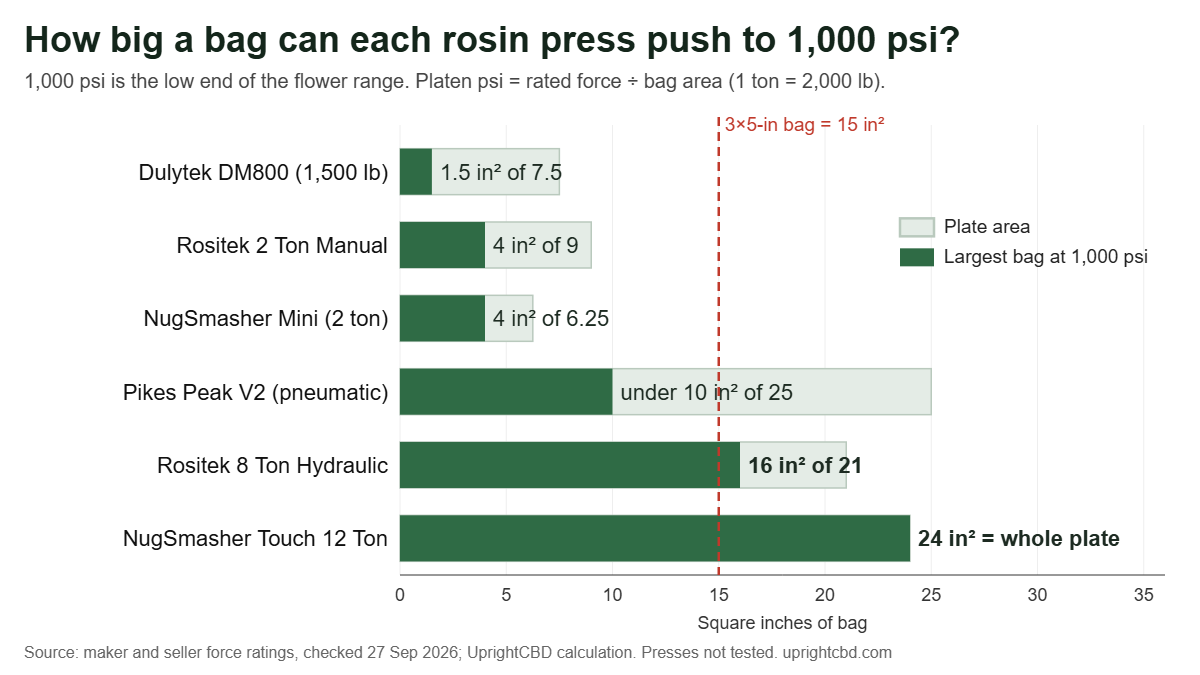
| Press | Rated force | Plate area | Largest bag at 1,000 psi (flower) | Largest bag at 500 psi (hash) | Pressure across the full plate |
|---|---|---|---|---|---|
| Dulytek DM800 | 850–1,500 lb | 7.5 in² | 0.85–1.5 in² | 1.7–3 in² | 113–200 psi |
| Rositek 2 Ton Manual | 4,000 lb | 9 in² | 4 in² | 8 in² | 444 psi |
| NugSmasher Mini | 4,000 lb | 6.25 in² | 4 in² | Whole plate | 640 psi |
| PurePressure Pikes Peak V2 (pneumatic) | Nearly 10,000 lb | 25–30 in² | Under 10 in² | Under 20 in² | Under 400 psi |
| Rositek 8 Ton Hydraulic | 16,000 lb | 21 in² | 16 in² | Whole plate | 762 psi |
| NugSmasher Touch 12 Ton | 24,000 lb | 24 in² | Whole plate | Whole plate | 1,000 psi |
Calculated by UprightCBD from each press’s rated force at 2,000 lb per ton, with a bag no larger than the plate. A press can deliver less than its rating, and none of these presses was measured. The Ju1ceBox is left out because its force is not specified.
The gauge on a hydraulic press does not show this number. Lowtemp notes that the gauge reads the pressure inside the hydraulic system, not the pressure on the plates. The bag matters most on small presses. Dulytek’s DM800 bundle ships 2×3-inch bags. Filled to the edges, a 2×3 bag gets 250 psi at the press’s higher 1,500 lb rating. That is half the 500 psi hash floor both sellers give.
Manual vs hydraulic vs pneumatic rosin presses
Manual presses use your arm on a lever or small jack and suit a few grams. Hydraulic presses use a bottle jack or pump for far more force. Pneumatic presses use an air compressor and cost the most.
| Type | What makes the force | Presses in this guide | Rated force | Price | Main trade-off |
|---|---|---|---|---|---|
| Handheld | Your grip on a heated clamp | Ju1ceBox | Not specified | $99 | No temperature or pressure control |
| Manual | Your arm on a lever or small jack | Dulytek DM800, Rositek 2 Ton, NugSmasher Mini | 850 lb to 2 tons | $199–$429 | Low force limits the bag size |
| Hydraulic | A bottle jack or hand pump | Rositek 8 Ton, NugSmasher Touch | 8–12 tons | $469–$2,676 | Heavier; the Rositek weighs 38.8 lb boxed |
| Pneumatic | An air compressor | PurePressure Pikes Peak V2 (reference only) | Nearly 5 tons | $7,995 | Needs a compressor and tank |
The pneumatic reference is PurePressure’s Pikes Peak V2. Its sellers describe “nearly 5 tons of force with only 120 PSI compressed air.” It needs a compressor delivering 120–145 psi at 1.7–2.2 CFM, with a 20–60 gallon tank. At $7,995, that is $1,599 per ton of force. Its 2×9-inch kit bag sees under 560 psi, inside the hash range but below the flower range. That makes it a hash press, not a first home press. Electric presses drive the plates with a motor instead, and none of the six here is electric.
The 6 best rosin presses for home use, by price
Ranked from cheapest to most expensive, the six cover handheld, manual and hydraulic designs from $99 to $2,676. Each review gives the rated force, the pressure it reaches and who should skip it.
1. Ju1ceBox handheld rosin press: $99
Best for: trying rosin with a gram of material before buying a real press.
The Ju1ceBox is a plug-in heated clamp with 1×1.5-inch plates that reach 250°F. Trimleaf’s review lists a 2-gram maximum, and the maker recommends 0.5–1 gram per press. A full cycle, including heat-up, takes about two minutes. Its force is not specified, so its pressure cannot be calculated. Trimleaf’s reviewer warns, “There is no temperature and pressure control,” so results take trial and error.
Skip it if: you want to repeat a result or press more than a gram at a time.
2. Dulytek DM800 manual press: $199 ($249 bundle)
Best for: very small pucks of kief or hash, if you accept a tiny bag.
The DM800 is a lever press with 2.5×3-inch dual heated plates. Dulytek’s own pages disagree on its force. The press page is titled 850 lb, while its spec list says 1,500 lb. The press page lists a 302°F maximum and the bundle page 356°F. At 1,500 lb, it reaches 1,000 psi only on a 1.5-square-inch bag, about 1×1.5 inches. The $249 bundle adds 15 bags of 2×3 inches, which the press cannot bring to 500 psi.
Skip it if: you want to press flower. At its rated force, only a bag the size of the Ju1ceBox’s plates reaches the flower floor.
3. Rositek 2 Ton Manual: $289
Best for: a few grams of flower at a time on a budget.
The Rositek 2 Ton is a lever press with 3×3-inch plates, temperature control from 0 to 399°F and a 5-gram capacity. Two tons is 4,000 lb, which reaches 1,000 psi on a 2×2-inch bag and 667 psi on a 2×3. That covers small flower pucks and hash. At $144.50 per ton, it has the second-cheapest force here. It weighs 18.5 lb boxed and carries a one-year warranty.
Skip it if: you plan to press more than about 5 grams at once.
4. NugSmasher Mini: $429
Best for: buyers who want a lifetime warranty on a small, portable press.
The Mini makes the same 2 tons as the Rositek 2 Ton, from a manual jack and pump arm. Its plates are smaller, at 2.5×2.5 inches, so a full plate gets 640 psi. Trimleaf lists up to 7 grams per cycle and dual 70-watt heaters with digital temperature control. NugSmasher backs it with a “True Lifetime Warranty” for the original owner. It was sold out at Trimleaf when we checked.
Skip it if: cost per ton matters most. The Rositek 2 Ton gives the same rated force for $140 less.
5. Rositek 8 Ton Hydraulic: $469 (our pick for most home growers)
Best for: most home growers pressing flower from a harvest.
The Rositek 8 Ton runs on a standard bottle jack, with no compressor or pump. It has 3×7-inch plates, dual PID temperature controllers up to 399°F and a 28-gram capacity. Its 16,000 lb of rated force brings a 3×5-inch bag to about 1,067 psi and a 2×4 to 2,000 psi. At $58.63 per ton, it is the cheapest force of the six by a wide margin. It weighs 38.8 lb boxed, and the warranty is one year.
Skip it if: you want a warranty longer than a year or a press you can carry easily.
6. NugSmasher Touch 12 Ton: $2,676
Best for: growers who press often and want the machine to do the pressure math.
The Touch pairs 12 tons of force with 4×6-inch plates and four 160-watt heaters. Its 5-inch touchscreen “calculates actual surface area PSI based on material weight and bag dimensions.” It connects to NugSmasher’s app over Wi-Fi or Bluetooth. At 24,000 lb, it reaches 1,000 psi across the whole plate and 1,600 psi on a 3×5-inch bag. Capacity is up to 28 grams of flower. The frame and structure carry a lifetime warranty.
Skip it if: you press a harvest a few times a year. The Rositek 8 Ton has the same 28-gram capacity for $2,207 less.
Rosin press temperature chart
Press flower hotter than kief or hash. Lowtemp suggests 190–220°F for flower, 180–200°F for kief and 160°F for hash, pressed for up to 60 seconds.
| Material | Triminator cold press | Triminator hot press | Lowtemp | Press time (Lowtemp) | Filter bag (Lowtemp) | Pressure (Lowtemp; Press Club) |
|---|---|---|---|---|---|---|
| Flower | 170–200°F | 200–220°F | 190–220°F | 15–60 s | 160 µm | 1,200–2,500; 1,000–2,000 psi |
| Kief (dry sift) | 130–170°F | 170–200°F | 180–200°F | 20–60 s | 25 µm | Not given; 500–1,500 psi |
| Bubble hash | 130–170°F | 170–200°F | 160°F | 20–60 s | 25 µm, doubled | 500–1,300; 500–1,500 psi |
In Celsius, 130°F is 54°C, 160°F is 71°C, 200°F is 93°C and 220°F is 104°C. Triminator and Lowtemp both make and sell rosin presses.
Heat trades volume against what survives in the rosin. Triminator puts it plainly: “Lower temperatures maintain the integrity of essential compounds but can yield lower volumes of rosin.” We suggest starting at the low end of a range and raising the heat in small steps if too little rosin comes out.
How to use a rosin press, step by step
Pressing rosin takes six steps, from bagging the material to collecting the rosin. Set temperature and pressure for the material first, because flower and hash need different settings.
- Choose the bag. Lowtemp uses 160-micron bags for flower and 25-micron bags for kief and hash, doubling the bag for hash.
- Pre-press the material. Pack it into an even puck, ideally with a pre-press mold, so pressure spreads across the whole bag.
- Work out the pressure. Divide the press’s force in pounds by the bag’s area in square inches. Aim for at least 1,000 psi for flower and 500 psi for hash.
- Heat the plates. Set them for the material from the chart above, and wait until both plates reach temperature.
- Press. Fold the bag inside parchment paper and center it on the plates. For hash, Lowtemp waits 10–30 seconds “until the hash starts to bubble at the front of the bag,” then applies pressure slowly. Hold for 15–60 seconds for flower or 20–60 for kief and hash.
- Collect the rosin. Open the press, lift out the parchment and scrape the rosin off with a clean tool. Keep hands clear of the plates, which Lowtemp flags as a burn hazard.
Step 3 decides whether your press can do the job. If the number comes out low, use a smaller bag or less material rather than more heat.
How much rosin press do you need?
For a few grams at a time, 2 tons is enough. For up to 28 grams per press, choose 8 tons or more, which brings a 3×5-inch bag of flower to about 1,000 psi.
| Material per press | Rated force | Largest bag at 1,000 psi | Presses here |
|---|---|---|---|
| Up to 2 g | Not specified | Unknown | Ju1ceBox |
| Up to 5–7 g | 2 tons | 2×2 in | Rositek 2 Ton, NugSmasher Mini |
| Up to 28 g | 8–12 tons | 3×5 in or larger | Rositek 8 Ton, NugSmasher Touch |
Capacities are the sellers’ figures. Bag sizes are UprightCBD’s calculation from rated force.
Your material comes from the harvest. Our guide on how to trim weed explains what trim holds and how a trim tray collects kief. Our drying and curing guide covers the steps between harvest and pressing.
Rosin press FAQs
What temperature should a rosin press be?
Lowtemp suggests 190–220°F for flower, 180–200°F for kief and 160°F for hash. Triminator’s cold-press ranges run lower, at 170–200°F for flower and 130–170°F for kief and hash.
How much pressure do you need for rosin?
About 1,000–2,500 psi on the bag for flower and 500–1,500 psi for hash, depending on the source. Work it out by dividing the press’s force in pounds by the bag’s area in square inches.
Is a 2-ton rosin press enough?
For small batches, yes. Two tons is 4,000 lb, which reaches 1,000 psi on a 2×2-inch bag of flower. On a 2×3-inch bag of hash it gives 667 psi, above the 500 psi hash floor.
Is a manual or hydraulic rosin press better?
Manual presses cost less and suit a few grams. Hydraulic presses make far more force, so they press bigger bags at flower pressure. The Rositek 8 Ton hydraulic costs $58.63 per ton of rated force.
Do you need an air compressor for a rosin press?
Only for a pneumatic press. The Pikes Peak V2 needs a compressor delivering 120–145 psi at 1.7–2.2 CFM, with a 20–60 gallon tank. Manual and bottle-jack hydraulic presses need no compressor.
What is the best rosin press for beginners?
For most beginners, the Rositek 8 Ton at $469, because it reaches 1,000 psi on a 3×5-inch bag without a compressor. For a few grams at a time, the $289 Rositek 2 Ton is enough.
What is the best rosin press under $500?
The Rositek 8 Ton Hydraulic at $469 is the only press here under $500 with enough rated force to bring a 3×5-inch bag to 1,000 psi. The Rositek 2 Ton at $289 suits smaller bags.
Can you press kief from a trim tray?
Yes. Lowtemp presses kief in a 25-micron bag at 180–200°F, and The Press Club puts dry sift at 500–1,500 psi. Our trim tray comparison covers trays that sift kief as you trim.
Which rosin press to buy
For most home growers, buy the Rositek 8 Ton Hydraulic. It has the cheapest force per ton here and reaches about 1,067 psi on a 3×5-inch bag. If you only press a few grams at a time, the Rositek 2 Ton Manual costs $180 less and covers small bags. Choose the NugSmasher Touch only if you press often and want the pressure math done for you. Whatever you buy, work out the pressure for your bag size before the first press. Rosin is a cannabis concentrate, and our guide on whether CBD dabs get you high explains how CBD and THC concentrates differ. Home cultivation and cannabis concentrates are legal only in some states, so check your state’s rules first.
Sources: Lowtemp Industries, “How to Find the Optimal Pressure for Your Rosin Press” (Levi Lanzrath; updated 14 July 2026) and “How to Use a Rosin Press for Top-Quality Results” (updated 5 May 2026); The Press Club, “Rosin Press Pressure Guide” (Viviane Schute; updated 31 January 2022); The Triminator, “The Ultimate Guide to Pressing: Rosin Press Temp Chart” (17 October 2024); Trimleaf, “Ju1ceBox Rosin Press Review” (Derek Randal; updated 16 September 2026); Trimleaf product pages for the Rositek 2 Ton Manual, NugSmasher Mini, Rositek 8 Ton Hydraulic and NugSmasher Touch 12 Ton; Dulytek product pages for the DM800 press and DM800 accessories bundle; Rightbud and BGHydro listings for the PurePressure Pikes Peak V2. All checked 27 September 2026. Lowtemp, The Press Club, Triminator, Trimleaf, Dulytek, Rightbud and BGHydro all sell rosin presses or accessories.

Recent Comments