

Does CBD Show Up on Drug Test? And How to Avoid a Positive Result? This article will guide you with evidence.
If you use cannabidiol for anxiety, pain, or general wellness, you’ve probably wondered: does cbd show up on drug test results? In most cases, no standard drug tests do not screen for CBD itself. They look for THC metabolites, which means CBD usually becomes a problem only when a product contains enough THC, even in trace amounts, to build up and trigger a positive result.
For anyone using CBD while facing workplace, probation, athletic, or other legal drug screening, that distinction matters. A misunderstanding about how tests work can put your job, benefits, or legal standing at risk. Here’s what the science actually says about why some CBD users still fail, how long THC and CBD can remain detectable, and what steps can reduce your chances of an unintended positive test.
Table of Contents
Quick answer: can CBD make you fail a drug test?
Standard drug tests do not look for CBD itself. They screen for THC metabolites, specifically THC-COOH, which is the breakdown product of delta-9-tetrahydrocannabinol – the psychoactive compound in marijuana. If your cbd oil or other cbd products contain even a small amount of THC, that trace thc can build up and potentially lead to a positive drug test.
Many CBD products contain trace amounts of THC. Legal cbd products in the U.S. can contain up to 0.3% THC under the 2018 Farm Bill, and full spectrum formulations intentionally include all cannabinoids from the hemp plant, including THC at that legal ceiling. The risk climbs with daily or high dose use because THC accumulates in fat tissue over time.
Here’s the uncomfortable part: a positive test result will simply read as cannabis or marijuana on the lab report. The lab cannot distinguish whether the THC came from a CBD gummy or a joint.
The good news is that product choice, dosing habits, and timing can significantly reduce risk. We’ll walk through exactly how below.
How drug tests work: what they actually look for
Understanding test mechanics explains why CBD is rarely the direct problem. Standard drug tests were designed decades ago to detect marijuana use. They target THC and its metabolites – not cannabidiol.
Most workplace drug testing follows a two-step process. First, a rapid immunoassay screens the sample against a cutoff threshold. A positive drug test for THC occurs at 50 ng/ml concentration in most U.S. Department of Transportation and employer panels. If the screen is positive, the sample moves to confirmatory testing (GC-MS or LC-MS/MS) with a lower cutoff, often 15 ng/mL.
Urine tests are the most common method for workplace drug screening. Here’s what each test type is best at:
- Urine – detects THC-COOH from recent days to weeks; the standard for employment and legal screening.
- Blood – captures parent THC for several hours after use; rarely used in routine workplace testing.
- Saliva – identifies recent exposure, typically within 24–72 hours.
- Hair – reveals repeated use patterns over approximately 90 days.
THC sensitivity varies with different drug testing thresholds, meaning a lower cutoff will detect smaller amounts for longer periods. Specialist research tests can detect cbd in oral fluid, but routine panels do not detect cbd as a target analyte.
CBD vs THC: why one shows up on drug tests and the other usually doesn’t
Both CBD and THC come from the cannabis plant, but they behave very differently in the body. THC is psychoactive – it binds strongly to CB1 receptors in the brain, producing a high. CBD is non-intoxicating and modulates the endocannabinoid system indirectly, which is why research by Zuardi AW, Crippa JAS, and colleagues published in journals like Cannabis Cannabinoid Res has explored its use for treatment of anxiety and other conditions.
Drug testing panels were established to monitor marijuana use. Because CBD wasn’t widely in commerce at the time, thc metabolites landed on the panel and CBD did not. Both compounds are fat-soluble and stored in body tissue, but only THC’s breakdown products – not CBD’s 100+ metabolites – trigger a positive result.
Full-spectrum CBD products often contain trace amounts of THC. Delta-8 THC and other analogues found in some hemp products can also cause a positive marijuana reading on standard tests. The takeaway: the presence of any THC metabolite above cutoff equals a positive, regardless of the source.
When CBD can lead to a positive drug test (main risk scenarios)
This is the core practical section. Any positive drug test result registers as THC, even if the person was only taking cbd for medical or wellness purposes.
Major risk scenarios include:
- Full-spectrum CBD with legal THC – even a small amount of THC (≤0.3%) can accumulate with daily use. Frequent or high-dose use of CBD can result in THC accumulation in the body, especially in individuals with higher levels of body fat.
- Mislabeled products – almost 70% of CBD products sold online are mislabeled, according to research from Johns Hopkins. Some products sourced from unregulated suppliers contain higher levels of THC than stated.
- High daily doses – consuming 50–200 mg of full-spectrum CBD oil daily delivers enough absolute THC that metabolites can cross screening thresholds.
Frequent use over weeks keeps thc content circulating in the body. In strict environments – Department of Transportation roles, military, probation – trace THC from CBD use creates a high risk situation.
Consider a daily user taking 100 mg of full-spectrum cbd oil for chronic pain who has a urine drug test for a new employer. After two weeks, accumulated THC-COOH could result in a positive, even though they never touched marijuana.
How long do CBD and THC from CBD products stay in your system?
People often ask “how long does cbd stay in your system?” because of an upcoming test. CBD can stay in your system for about seven days, but the real concern is how long THC metabolites linger.
Detection windows by test type:
| Test type | Detection window |
|---|---|
| Urine | Single use: 1–3 days. Heavy/daily use: THC can be detected in urine for up to 30 days |
| Blood | THC is detectable in blood for approximately 5 hours; metabolites may persist longer with frequent use |
| Saliva | THC can be found in saliva for about 72 hours |
| Hair | CBD can be detected in hair for up to 3 months; THC metabolites follow similar patterns |
When you consume CBD as food or edible, the digestive system processes it through first-pass metabolism in the liver, producing 11-OH-THC – a metabolite that tests can detect. What happens in your stomach during digestion matters, though in vivo studies show CBD does not meaningfully convert to THC despite some alarming lab-only findings.
Body metabolism affects how quickly THC is processed and eliminated. Other factors include dose, frequency of use, body fat percentage, and hydration. “Detox drinks” and extreme water intake have limited and unreliable ability to shorten detection windows.
Common reasons CBD users fail a drug test
Here are the main technical and product-related causes that can cause a positive drug test, along with other reasons that are less common but still worth knowing.
THC in the product itself. Full-spectrum CBD products often contain trace THC levels. Large daily doses of these products deliver enough THC to cross the 50 ng/mL immunoassay cutoff used by most labs. CBD products can legally contain up to 0.3% THC, but that’s not zero.
Mislabeled products. Improper labeling of CBD products can lead to greater THC content than indicated. One study of 105 topical CBD products found 35% contained detectable THC – including items labeled thc free. Not all CBD products labeled as THC-free are guaranteed to be free of THC.
Cross-contamination. Cross-contamination can introduce THC into CBD products when CBD and high-THC cannabis are processed on shared equipment. This is especially common with smaller, less regulated manufacturers.
Rare mechanisms. Some in vitro research explored whether CBD converts to THC in acidic stomach conditions. While conversion occurred in artificial lab environments, animal and human studies have not confirmed this happens meaningfully in vivo. Contamination and mislabeling remain far more likely explanations.
Secondhand exposure. Heavy secondhand cannabis smoke (“hot-boxing”) is a low-probability but not impossible cause, particularly for hair analysis. Women who are breastfeeding should also know that cannabinoids can transfer through breast milk, though this relates more to safety than testing.
How to use CBD and lower your risk of a positive drug test
No strategy is 100% foolproof, but informed choices can dramatically reduce risk.
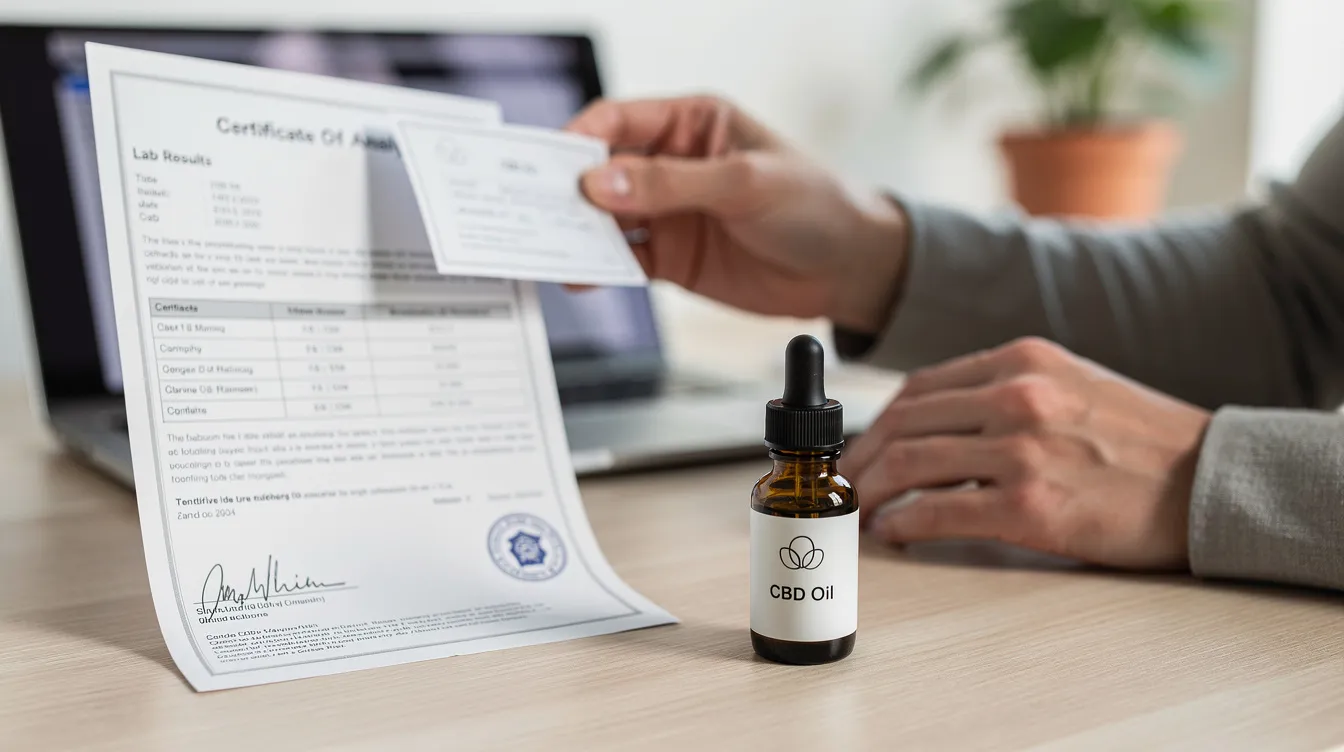
- Choose CBD isolate or broad-spectrum products explicitly labeled “0% THC.” Using third-party tested CBD isolates can minimize THC contamination risk. Look for certificates of analysis (COAs) showing “ND” (not detected) for THC.
- Buy from reputable brands that publish batch-specific third party lab testing results with exact cannabinoid content, manufacturing dates, and lot numbers. Growing consumer demand for transparency has pushed better brands to provide this voluntarily.
- Avoid full-spectrum CBD if you have upcoming workplace drug testing, work under Department of Transportation rules, or face legal testing obligations. Products sourced from verified, regulated supply chains are safer.
- Keep doses moderate. Very high doses (above ~2,000 mg/day) of any CBD product increase the chance that trace THC will accumulate to detectable levels.
To protect yourself further: read labels carefully, keep product packaging and lab reports, and consider discussing cbd use with your employer’s medical review officer or HR department before a test – understanding that this does not guarantee leniency after a positive result.
What happens if you test positive after using CBD?
On a lab report, there is no distinction between THC from recreational cannabis and THC from CBD products. Any confirmed level above the cutoff is simply a positive.
Workplace consequences:
- In zero-tolerance settings, a confirmed positive test can lead to suspension, removal from safety-sensitive duties, or termination. A failed drug test stays on record in many regulated industries.
- For DOT-regulated transportation workers, a positive THC result means immediate removal from duty and a formal return-to-duty process. A truck driver who tested positive due to a mislabeled CBD hemp product lost his job – the court allowed him to seek damages, but that didn’t undo the career disruption.
Most employers, courts, and regulators do not accept “I only used CBD oil” as a valid explanation for a positive drug test result. Medical review officers may review prescriptions for FDA-approved CBD medications (which contain no THC), but over-the-counter CBD supplements usually do not affect the outcome.
If you’ve already received a positive result, request a copy of the lab report and any confirmatory test data, review your company’s drug testing policies and appeal procedures, and seek legal or employment law advice if the result threatens your job or license.
In conclusion ( Does CBD Show Up on Drug Test?)
Standard drug tests do not target CBD – they target THC. But trace THC in CBD products, combined with mislabeled products and frequent use, can absolutely lead to a positive. The gap between “legal” and “test-safe” is real. Choosing verified isolate products, sticking to moderate doses, and understanding your testing environment are the most practical ways to protect your career while still benefiting from CBD.

Recent Comments